Innovation method

Turn the cube.Find the idea.Build the strategy.

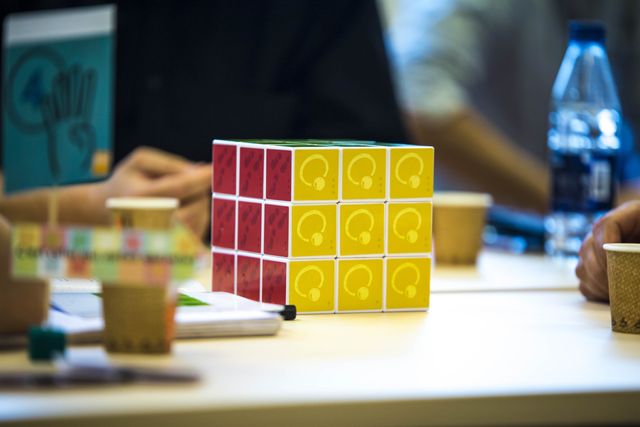
Fill a cube with your model, mix it, and compose ideas that are feasible, original or disruptive.

Read the first 23 pages for free
  • Published by Pearson France
  • Created by Hélène Michel
  • Workshops by Opopoï

Spin the cube

See how it works

The challenge

Good ideas come neither from pure chance nor from the perfect plan.

Testing every possible combination in a spreadsheet exhausts teams; planning-heavy approaches narrow the view and discourage change. Unstructured brainstorming, meanwhile, keeps raising the same question: “Is it a good idea?”

Cubification takes a middle path: rigour and randomness, rules and play. Like the Oulipo writers who invented under constraint, the method sets a precise frame to free the imagination, and opens innovation to people outside R&D, design or marketing.

  • Make it tangible

    The cube turns a complex situation into visible elements you can handle and rearrange.

  • Involve everyone

    Play creates a “magic circle” where making mistakes is allowed, whatever your job title.

  • Qualify ideas

    A star score separates what can launch quickly from what belongs to the long-term vision.

The method

An innovation tale in three stages

Cubification borrows the structure of fairy tales: a central character, a setting, an auxiliary, a disruptive element, a quest and a reward. Each element becomes one face of the cube. The aim is not to solve the cube but to “disrupt” it.

  1. Determine your model

    The team fills the six faces in this order: users, places, resources, game changers, advantages, revenue stream. One item per square, nine per face, spread across three star levels.

    What the team produces A fully completed cube: your innovation model.

  2. Imagine your innovation tales

    Mix the cube. Pick a side where every colour appears at least once, keep six items of different colours, then tell the idea using a set narrative structure.

    What the team produces Idea sheets, each with a name and a slogan.

  3. Evaluate their potential

    Add up the stars of the six items used. The total places the idea in the short, medium or long term, and on an innovation roadmap.

    What the team produces A roadmap: within 6 months, 6 to 18 months, beyond.

Where an item sits on a face tells you how familiar you are with it. That is what makes the score possible.

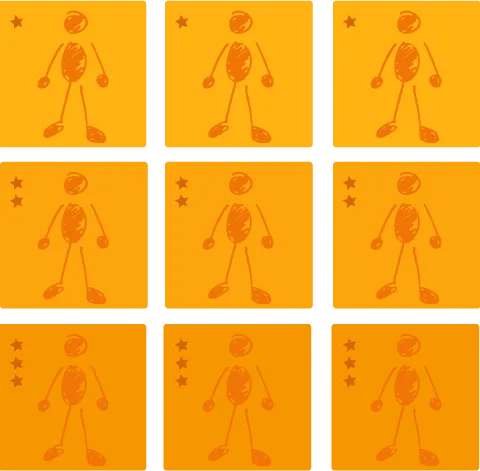
Every face reads in three rows

  1. 1 star

    What you already do, better than your competitors

  2. 2 stars

    What your competitors already do, and you don’t yet

  3. 3 stars

    What nobody does yet, but has real potential

Add up the stars

  1. 6

    Feasible

    You play safe with elements you know well. It could be put in place quickly.

  2. 7 – 11

    Original

    You leave your comfort zone, mixing what you know with harder elements. Medium term.

  3. 12+

    Disruptive

    You explore uncharted territory. Sometimes a visionary idea, for the long term.

An organisation needs all three types of ideas to work in the short, medium and long term.

The narrative structure

What product or service could you imagine for user, by using resource in place? This would allow the user to advantage. And besides, all this could work game changer. This would be funded through revenue stream.

From the English edition of the book (p. 74).

A typical session

The book describes nine activities that facilitators combine depending on the playground:

  1. Pre-fill the cube
  2. Mobilise the group
  3. Unveil hidden talents
  4. Surpass functional fixity
  5. Complete the cube
  6. Present the different cubes
  7. Imagine your innovation tales
  8. Present your innovation tales (30-second pitches)
  9. Draw your roadmap

Inside the cube

Six faces, one story

Each face of the cube carries one dimension of your innovation model. Drag the cube or pick a face to explore its question.

Drag the cube or pick a face

Users

Face · Orange — In the tale: the central character

Who are you creating this product or service for?

Specific profiles, not a generic target: the person who uses the offer, even if they are not the one who buys it.

Three rows on every face

  • 1 star What you already do, better than your competitors
  • 2 stars What your competitors already do, and you don’t yet
  • 3 stars What nobody does yet, but has real potential
Static illustration of the six faces

Try it

Compose an idea

Illustrative example

A glimpse of the principle, using the book’s worked example: “a new food service offer”. Pick one item per face and watch the sentence and score update. In a real workshop, your team fills the cube and the faces get mixed.

Choose an item for the Users face
Choose an item for the Places face
Choose an item for the Resources face
Choose an item for the Game changers face
Choose an item for the Advantages face
Choose an item for the Revenue stream face

Your innovation tale

What product or service could you imagine for workers , using local products , at a restaurant ? It would allow them to eat . What if all this was… vegetarian ? Funded through sales .

6 stars Feasible idea

Total: 6 stars. Feasible idea.

A simplified demonstration built for this website; it does not replace a session. Items taken from the book’s example, pp. 68–73.

Use cases

Seven playgrounds, from one person to a thousand

The book identifies seven situations, based on two questions: what stage is your project at, and how many people are involved? Each is illustrated by a real case described in the book.

  1. Personal development

    Re-think your career

    Case described in the book A career change project, played individually

    Players: 1 person

  2. Entrepreneurship

    Create the first offer of your start-up

    Case described in the book Windalps, a start-up at the Technolac incubator (Savoie)

    Players: 3 to 5

  3. Business development

    Develop your offer to explore new markets

    Case described in the book Maped

    Players: 6 to 12

  4. Change management

    Develop a team’s agility and creativity

    Case described in the book Bibliothèque nationale de France (BnF)

    Players: 12 to 25

  5. Innovation training

    Apply concepts to concrete examples

    Case described in the book UNCTAD’s Empretec programme

    Players: 20 to 40

  6. Innovation consultancy

    Help organisations re-think their strategy

    Case described in the book Natixis EuroTitres

    Players: 6 to 80

  7. Open innovation

    Open up your innovation issue, up to a hackathon

    Case described in the book Somfy

    Players: 50 to 1,000

Who is it for?

  • Innovation and strategy leaders

    Explore markets, qualify options and connect quick wins with long-term bets.

  • Facilitators, consultants and trainers

    A complete workshop format, from pre-filling the cube to the roadmap, scalable to the size of the group.

  • Educators and researchers

    Put innovation management concepts into practice with groups of 20 to 40 people.

These are the benefits the method aims for. Results reported in the book concern specific cases and are not a guarantee.

Foundations

Academic depth, made playable

Cubification is not just another game: it turns established work in innovation management, game design and the social sciences into a simple rule you can hold in your hands.

  1. Play opens a protected space

    Johan Huizinga’s “magic circle”: time set apart, with its own rules, where you can experiment and get things wrong.

    Huizinga, Homo Ludens (1938)
  2. Tales give ideas a structure

    Character, setting, auxiliary, disruption, quest, reward: narrative structure becomes a model for an offer.

    Bettelheim (1976); Propp (1968)
  3. Constraints spark creativity

    The Oulipo of Queneau and Perec, and research on why people enjoy constrained creative experiences.

    Queneau (1961); Dahl & Moreau (2007)
  4. Strategy draws on resources and value

    Edith Penrose’s types of resources, and the required, expected, desired and unexpected benefits of a value proposition.

    Penrose (1959); Osterwalder et al. (2014)
  5. Non-experts innovate too

    User innovation and user toolkits, and double-loop learning that questions the rules themselves.

    von Hippel (2001, 2005); Argyris & Schön (1978)
Hélène Michel speaking on stage

The creator

Hélène Michel

Professor of innovation management, Grenoble École de Management · Game designer

Hélène Michel holds a PhD in management science (Université de Savoie, 2004). Her research focuses on using games to support innovation and inspire entrepreneurship. She designs serious games and gamified innovation methods, Cubification among them.

Her research projects have been conducted in collaboration with the Massachusetts Institute of Technology. She works as an expert for research agencies and co-founded Opopoï, the agency that runs Cubification workshops.

The turning point? A serious game about raising a virtual cow, Vacheland, which drew more than 400,000 players within a few months. In the book’s introduction she explains why it convinced her to study what motivates players.

The book

The whole method, explained and illustrated

Published by Pearson France, Hélène Michel’s book sets out the principles of gamification, walks through the Cubification method step by step, then tests it on seven real playgrounds.

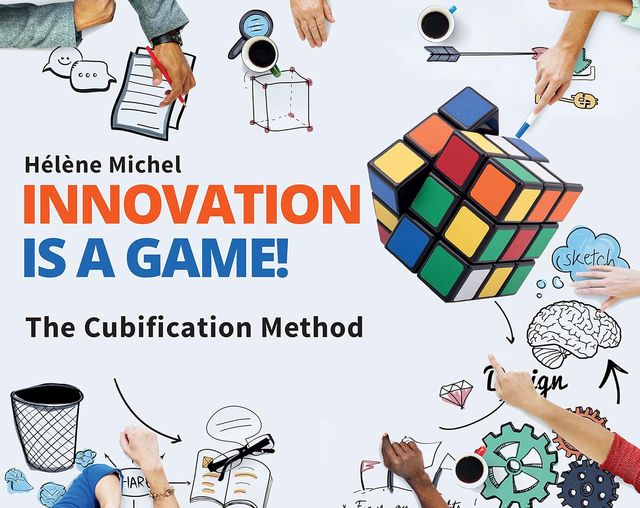
Cover of “Innovation is a game! The Cubification Method” by Hélène Michel: a Rubik’s Cube on a work table surrounded by sketches
English edition
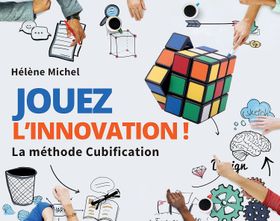
Cover of the original French edition, “Jouez l’innovation ! La méthode Cubification” by Hélène Michel
Original French edition

Inside

  1. The principles of gamification

    Seven illustrated principles, the theoretical foundations of game mechanisms and their challenges in management.

  2. The Cubification method

    Founding principles, key steps and how to run a session in nine activities.

  3. Playgrounds

    Seven cases: career change, start-up, business offer, change, training, consultancy and open innovation.

Who is it for?

For anyone who wants to re-think a career, launch an entrepreneurial project or open up their approach to innovation, whether with a small team or a large group.

Editions
Original French edition — Jouez l’innovation ! La méthode Cubification
Publisher Pearson France
Published 25 August 2017
ISBN 978-2-326-00148-0
Ebook (ISBN) 978-2-326-05379-3
Pages 175 pp.
Format Paperback, 19 × 24 cm, colour illustrations
Foreword Xavier Niel
BnF record BnF record (opens in a new tab)
English edition — Innovation is a game! The Cubification Method
Publisher Pearson France
Published 2018
ISBN 978-2-326-00233-3
Pages 175 pp.
Format Paperback, 19 × 24 cm, colour illustrations
Foreword Xavier Niel
BnF record BnF record (opens in a new tab)

Read the first 23 pages for free

English edition

Xavier Niel’s foreword, “Who is this book for?”, the author’s profile, the introduction and the start of chapter one. No sign-up, no email.

This excerpt comes from the English edition, “Innovation is a game!”.

Loading the preview…

Left and right arrow keys: change page

Excerpt: PDF pages 1 to 23 of the English edition, © 2018 Pearson France.

Buy the book

At the booksellers we checked on 29 September 2026, both print editions were listed as out of print. Copies are still offered by third-party sellers, often second-hand; availability varies.

You can also consult it in libraries, for example at the BnF.

Links checked on 29 September 2026.

In practice

Cubes, markers and ideas taking shape

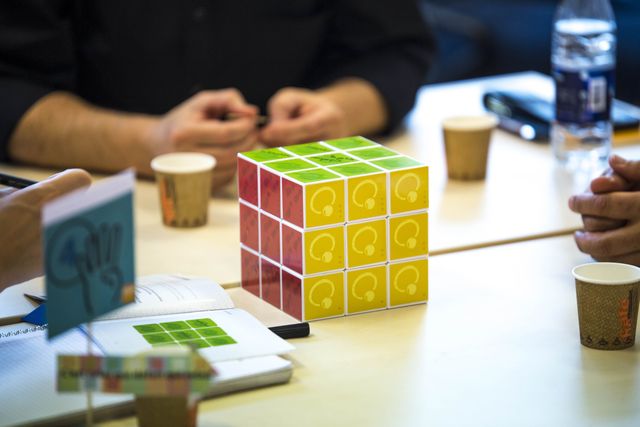
A cube with green, red and yellow faces on a meeting table, between participants’ hands
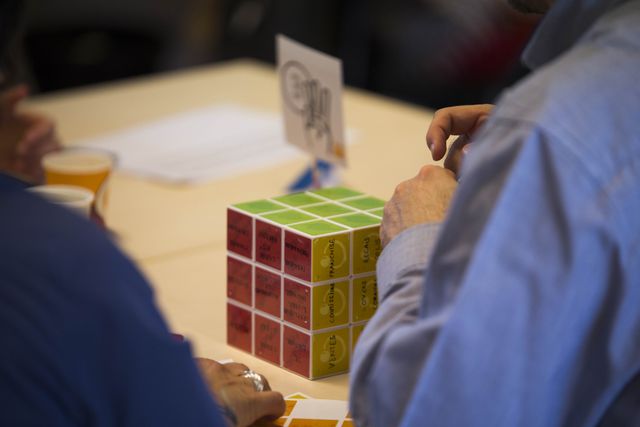
A cube whose red and yellow stickers are annotated in marker during a workshop
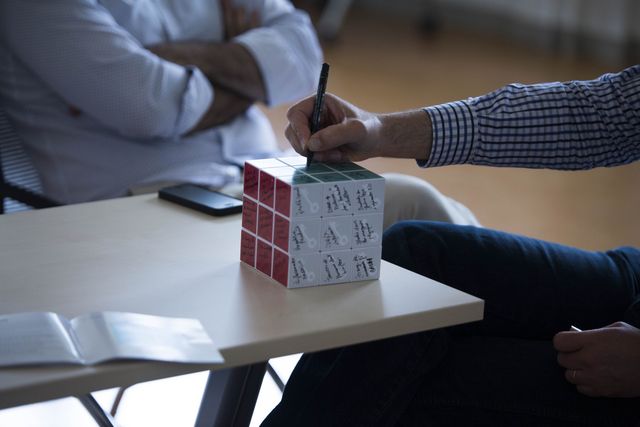
A participant writing in marker on the white face of a cube
A completed cube with red and yellow faces on a workshop table
Cubification workshop. Photo: Opopoï.

“We came to play and, suddenly, we enter into strategic thinking.”

Serge Darrieumerlou
20
Somfy managers (R&D, innovation, production, sales, marketing) working for half a day
4
cubes completed by four groups
24
ideas, turned into scenarios by a graphic facilitator

Seminar described in the book, p. 163.

Powered by Opopoï

A Cubification workshop for your team

Opopoï is a Paris-based workshop design and facilitation agency, founded in 2015 and co-founded by Hélène Michel and Mathias Salanon. It designs and runs Cubification workshops in French and English.

Pearson France publishes the book; Opopoï supports teams who want to play the method together: preparing the cube, facilitating the session and sharing the results.

  • Hélène Michel Author of the book, creator of the method
  • Pearson France Publisher of the book
  • Opopoï Workshop design and facilitation

They played with the cube

  • Somfy
  • Capgemini
  • Maped
  • Natixis
  • BnF — Bibliothèque nationale de France
  • UNCTAD (CNUCED)
  • Windalps
  • EDHEC Business School
  • CentraleSupélec
  • Grenoble École de Management

FAQ

Frequently asked questions

Do I need to know how to solve a Rubik’s Cube?

No, and it’s even better if you don’t. You never try to restore the faces: you mix the cube to create combinations, then ideas.

What materials do I need?

A Rubik’s-type puzzle cube (or a bigger one), personalised stickers in the colours of the six faces, a permanent marker and idea sheets. For materials or a facilitated session, contact Opopoï.

How long does a session take?

The rules booklet plans about three hours: an hour and a half to build the model, the same to imagine ideas. For sessions shorter than three hours, the book recommends pre-filling part of the cube. The cases in the book range from two and a half hours to a full day.

How many participants?

You play in teams of three to six. According to the book, one facilitator can coordinate up to six teams, or 36 participants. The method also works alone, to re-think a career, and has been played by several hundred people at a hackathon.

What does a workshop produce?

A completed cube that captures your innovation model, idea sheets (six per team during the ideation stage, in the book), 30-second pitches and a roadmap that separates feasible, original and disruptive ideas.

What exactly is the free preview?

The first 23 pages of the English edition PDF: title page, contents, Xavier Niel’s foreword, who the book is for, the author’s profile, the introduction and the start of chapter one. No sign-up, no email.

Is the book available in English?

Yes. The English edition, “Innovation is a game! The Cubification Method”, was published by Pearson France in 2018 (ISBN 978-2-326-00233-3). The French original, “Jouez l’innovation !”, came out in 2017.

Where can I get the book?

The print editions are listed as out of print at the booksellers we checked. Copies are still offered by third-party sellers: see “Buy the book”.

Can I run the method myself?

The book is written to help you organise your own sessions: stages, activities, timings and examples. For commercial use or licensing questions, contact Opopoï.

Ready to mix up your ideas?

Talk to Opopoï about a workshop, or start by reading the first pages of the book.